Sunday, June 10, 2012

Sketches of Home

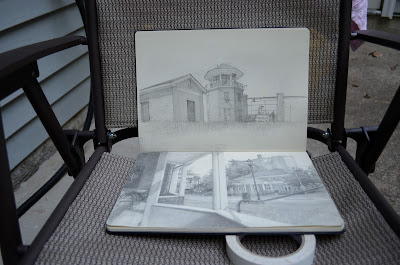
On second thoughts, forget scanning.  I'm moving on to posting photos with all their distorted angles, and only I shall have the perfect proprietary original ;). Anyway, here are some home-themed sketches. I'm sorry these are in hard pencil and you have to strain your eyes. I can't explain why, but I like them that way. It has something to do with the process - how pencil feels on paper - and with how private and intimate this makes the drawing. You have to look close. They aren't really meant for the contrasts of internet, but here they are nonetheless.


But okay, by now I've had enough of timid penciling and want to do something bolder. The garden bird bath and my dog on the couch are two relatively quick sketches done in Faber Castel PITT Big Brush pens. It's almost unfair how quickly four grades of grey establish all the values you need, while pencil demands that you labor on shadows for hours. But detail is of a different caliber. Here things are blocked off haphazardly. There is no detail to speak of really. It's a quick impression, and it emerges from the page, while you work on it, in a way that's like slow motion photo developing process in a dark room (if anybody remembers those days).

Saturday, June 9, 2012

Larger Format and Big Ideas

I have not posted any updates in a long time. But I have been drawing! Here is a small sample of sketchbook pages from... well I guess last Fall till now. I will need to get around to a scanner to get them all. These are done in a Moleskine Folio Sketchbook, which does not take ink at all, but has a delicious feel when working with pencil. Marker ink seems to work alright, and I have yet to try a Rapidograph. But no washes with this paper - it just ends up with droplets beading up and ugly soaked paper towel look. If anybody knows what exactly about paper processing causes it, please tell me. 

Moving to a slightly larger format for sketches has pushed me to spend more time on each drawing. In fact the boundary between sketch and drawing proper is not entirely clear cut. I love the meditative sinking in the drawing process, but some quick spontaneity is important to keep on hand. 

Waqar Studying

Charlottesville, VA

My Father. Topological Craziness of the Ceramic Teapot.

Lorton Prizon Tower. Views of Charlottesville #1.

Views of Charlottesville #1 (up close)


After a semester-long hiatus from art for the purposes of studying cell biology and anatomy, and working, I am now embarking on a summer of art, full force. To warm up I started with teapot drawing, moving away from the light touch feel of hard pencil (which I still dearly love) to a fuller value range. I know everybody loves drama, but I am partial to a subtler look.

After spending seven hours on reflections in the teapot, I found myself returning to the same spot on Main Street in Charlottesville for three days, for four to five hour drawing sessions, and then reworking the drawing at home as well. This is the reason why truly developing a body of work is a full-time job. With this drawing I am just finally getting a feel for where I want to go with my tools and my peculiar views on drawing as Alternative Journalism.

Views of Charlottesville #1 (so you can actually see it)


Apart from actually grasping the scene, which is a bizarre obsession in itself, there is one thing, one question that I keep rolling over in my mind: will the meditative reiteration of a scene, will realism, will my handwriting betray an emotion? There were days when I drew emotions directly, or through some sort of personal psychosymbolic lore. It seems a completely boring path now, far too trivial for emotions that would probably not even be caught on the radar of a teenage mind, mine at least.

Yet there is no lack of drama in the subtler unfoldings of life. In fact it is the realm where most mystery exists. It's a realm of earthy steady heartbeat, or the fall of a leaf, or the softness of moss, or the carving of canyons. It's a terribly patient species of human experience, and to evoke and investigate that, I do not see any other way than to trust the process. To trust that the thought will be recorded in the marks that otherwise describe some very specific forms before my eyes.


Casa Peruana Revisited


After a long time, I pulled this piece out from the file to see if I can bring it to completion. It seemed too constrained in feeling and empty. The entire shadowed-house region just seemed devoid of life and stuck on as an after-thought. Something needed to flow and give depth to the scene without breaking its slightly-off melancholy. I realized I needed to stop treating the pencil drawing as so precious and just go ahead and paint over it in a messier way, to build some age to the walls, some fractals to the stones and sky.

Noting how much bold lines add to an otherwise perfectly self-conscious form building in my images of trees, I realized that the armature of unfinished buildings that populates Peruvian cityscapes is a perfect candidate for such lines. And to have an etherial sort of plastic bag stuck on the armature, catching wind, like a trashy flag of our times -- I thought that would give that empty region of the picture some breath.

The piece is still far from finished. Unlike observational works that are complete when they are complete, this sort of unearthing of a personal (and far from emotionally dramatic) vocabulary is proving to be an indefinite process. I have some ideas of where to take this next, but it's all sort of amorphous. And there is no turning back: much of the painstaking pencil work is bound to be destroyed. That difficulty alone (I was stupid to combine these materials) made me realize a much better approach would have been a lithograph with color watercolor washes. That is really the look I had in mind, but it took some research to find out that it even exists. For now though I will take this where it wants to go, and certainly away from the awkward pallet. The sky needs more emptiness, the house more context, the bag less pink.


Thursday, September 1, 2011

Depression Glass Fruit Vase


I painted this oddly green still life in July and I am rather proud to say that this was my first attempt at watercolors since... pretty much childhood. I was actually on point with color accuracy. You can see how the camera struggled with the darks. Still though... the scan washed that accuracy out. I cannot restore the lost subtlety. And who knows what the colors will appear like on the screens, but so be it. I will need to learn to scan in a way that better emulates room lighting.

I am finally becoming interested in the surface treatment and materials, colorfast pigments and archival quality paper. The ease and glitz of digital art, as was once to my great annoyance predicted by James Miller, the head of VCU Communication Arts Department, has left a gaping whole in my self esteem as an artist. Because there is simply nothing there to hold. But now there is such a sense of meditative... balance, of return to self, in working with actual physicality of materials.

So used to thinking of materialism in negative terms, one forgets that it is symbolism that is the issue, while the material is mere reality, naked and direct, assuring one's being. There is much more to say on the matter. Now I feel that I have only cracked the door toward proper painting and its psychology. I wonder if massage therapy has taught me something about form I could not quite articulate before... and am now expressing in a sort of baby-babble...

Oh yes... I cheated. There is some gouache in the drapery.
 

Inkwash Sketches

 A Castle in Czech Republic
Nadya Semirenko (Monastyrskaya) as a vagabond teenager circa 1999

Thursday, June 9, 2011

End of a Sketchbook

Waqar Khan (over wings)

Justin Faria (over coffee)

Merry Go Round


There is a sort of reckless abandon in the growth, struggle and force of organic forms that is entirely absent in much of human-made structures. Perhaps it is achievement of transcendence of the timidity of human geometric thought that takes a drawing to a realm beyond linguistic comfort - closer to the directness of music.

In approaching man-created subjects then (such as this carousel horsey), perhaps the focus should be (once the structure of the drawing is establisged or even before that) on the natural, accidental, organic elements still: rust and play of light on the surface.

It is a dangerous habit - putting of drawings till later. I have been intending to come paint this tree in the neighborhood where I work, marveling at it every time I passed it by. Did this quick sketch at lunch break once, and two days later the majestic tree was cut down. It's mulch now.